Chronology
This chronology was developed in preparation for the retrospective exhibition “Mimi Chen Ting: Make Movement Visible” organized by BYU Museum of Art, April 2026. (Citation: Ting, Andrew, Cheryl Ting, Clarence Ting, Maia Moredock-Ting, Dylan Moredock-Ting, and Jason Andrew. Mimi Chen Ting: Make Movement Visible. Edited by Miri Kim. Hudson, in association with Brigham Young University Museum of Art, 2026)
1946
July 8: Mimi Chen Ting is born in Shanghai, China to Souching Loo and Wei Foo Chen during a time of intense political turbulence and transition. Mimi is raised alongside four half brothers (Robert, David, Peter) and sister (Irene) from her father’s first family and two brothers (Percy and Chris) in what she considered “old feudalistic China” in a compound with a shared courtyard.
Of her early childhood, Ting recalled:
“I remember coloured lanterns, the man who popped rice for us on the street, waiting at the gate for Uncle to bring sweets, and riding in the horse carriage—or perhaps it was a bicycle carriage—in the rain, with the rubber cover down....”
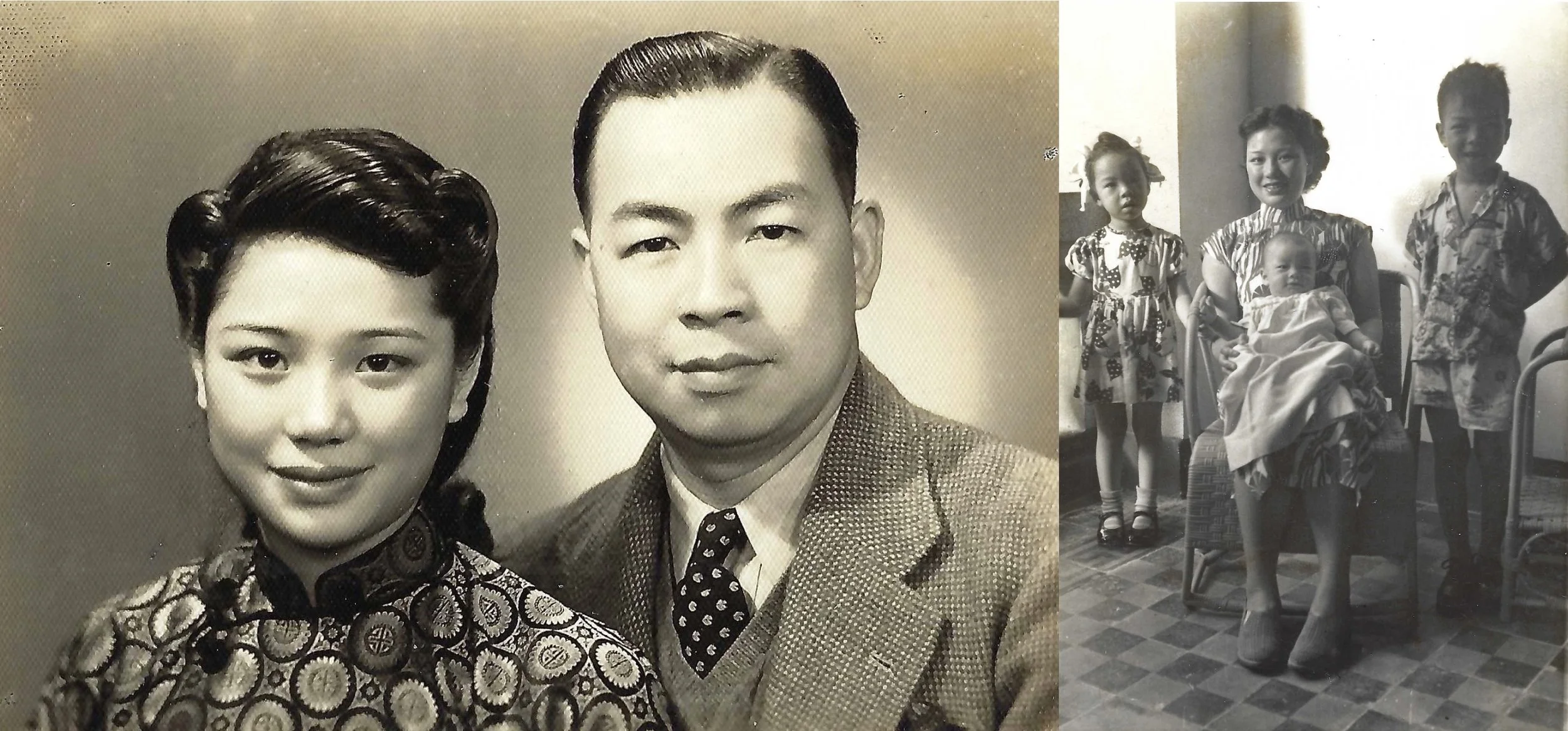
Left: Souching Loo and Wei Foo Chen (mother and father), c.1945. Courtesy of Andrew Ting.
Right: (Left to right) Mimi, her mother, and brothers Chris and Percy, c.1949. Courtesy of Andrew Ting.
c. 1949
1965
1967
1968
Ting’s father finds success working in banking for the Song Brothers. Ting’s family moves to an apartment in Hong Kong by the South China Sea. As a child, Ting spends time on the apartment balcony,experiencing a great “sense of space.”
Ting attends Maryknoll Convent School and receives a “Catholic upbringing.” Uses her allowance to purchase paper at the corner store for 30 cents. Her drawings appear in the South China Morning Post. The nuns at Maryknoll Convent School leverage Mimi’s artistic proficiency for the classroom:
“Since first grade in Hong Kong, I had been asked (told) by the nuns to make feast-day cards and Christmas decorations. Perhaps they were the first to realize I had a talent for art (which I would just call an insatiable longing to make visible).”
Ting studies ballet, yet this early formative experience in dance is cut short by her mother over concerns about becoming “too muscular.” Ting’s grandmother and father take the artist to Buddhist temples and Chinese opera performances, respectively, shaping Ting’s early encounters with color, calligraphy, music, and theater. Regarding the Beijing Opera, Ting notes, “it was the color of the costumes...the dramatic movements of these, that I think I was drawn to.”
The Immigration and Nationality Act of 1965 abolishes the quota system in the United States, leading to increased immigration from China.
March 8: The first U.S. combat troops, 3,500 Marines, landed in Da Nang, South Vietnam. Their initial mission is to defend U.S. air bases, but this quickly expands to include search and destroy missions and the beginning of the war in Vietnam.
Ting enrolls at the San Francisco College for Women with the intention to study English literature and sociology (“I thought I wanted to be a librarian or a social worker”). Throughout her studies, Ting regularly takes art classes.
During Christmas, she meets her future husband, Andrew Ting, in Berkeley, CA.
Visits the Grand Canyon for the first time, where she is captivated by the land. “I was so impressed.... I think it just changed my perspective,”Ting later noted.
Becomes involved with social movements in the Bay Area, such as the Free Speech Movement and protests against the Vietnam War. Sees Robert F. Kennedy at a rally shortly before the presidential candidate is killed in 1968. Ting recalls, “it was a very awakening time.”
Leaves San Francisco College for Women to study art at what is now San Jose State University, formerly California State University. Abandons the idea of becoming a social worker. Learns about the artists of the early Italian Renaissance, such as Piero Della Francesca, describing their works in terms that resonate with her future paintings: “I liked the simplified forms, the flatness against each other. I liked the dynamic between the forms.”
Works two jobs at a restaurant and liquor store in order to support herself and afford art materials.
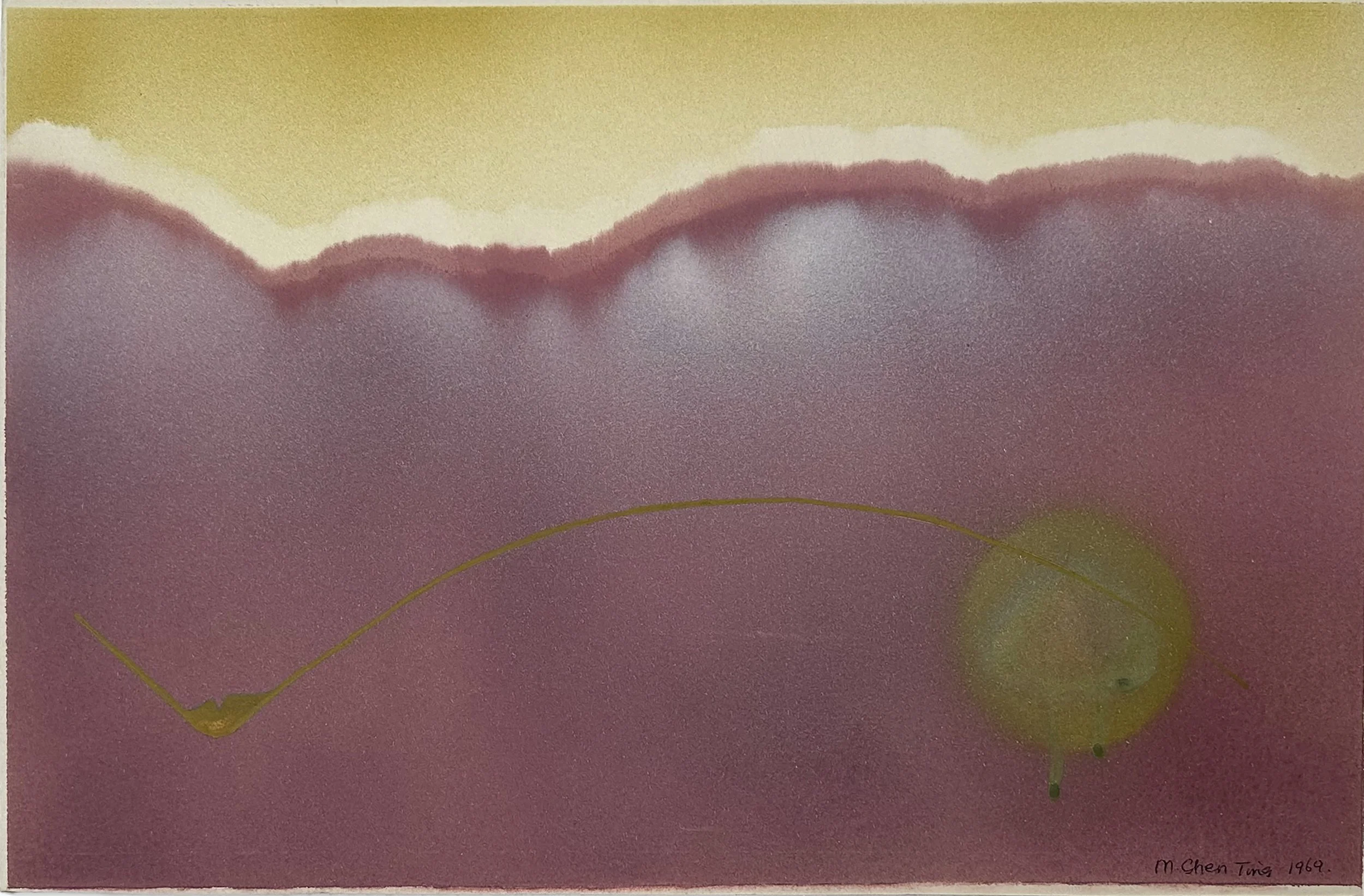
Untitled Work on Paper, 1969
1969
Graduates from San Jose State University (SJSU) with a B.A. in Art. Enrolls in the M.A. program at SJSU.Marries Andrew Ting on July 3.
1970
January 23: Her first child, Cheryl, is born.
October: Eric Oback, a supportive SJSU art faculty member specializing in watercolor, encourages Ting to contact the Lucien Labaudt Gallery in San Francisco, resulting in Ting’s first solo show.
The exhibition features Ting’s abstract landscapes stemming from her visit to the Grand Canyon, painted in acrylic on paper to evoke the effect of watercolor: “The work was my faking watercolor with acrylic and I also used spray cans.” Ting recalls making the works “in the corner of my bedroom lined with newspaper, while my infant daughter [Cheryl] slept and played among pillows in our bed.”
Invites the art critic Thomas Albright at The San Francisco Chronicle to see the show. Albright’s review draws attention to Ting’s “exquisitely delicate and sensitive landscape abstractions involving sinuous outlines, pastel colors and silvery halos that seem to float over ridges and horizons like the fog banks in traditional Chinese landscape paintings” while also noting that the emerging artist “has a way to go technically, but her work reflects a nicely poetic and personal sensibility.”
1971
Awarded Second Prize in Painting at the Lodi Arts Festival, Lodi, CA.
1972
December 31: Her second child, Clarence, is born.
1975
April 30: End of the Vietnam War.
Participates in women’s consciousness-raising groups at SJSU led by artist Jessica Jacobs. These groups include Loie Johnson, Salli Robertson, Susan Kirkpatrick, Judy Lacy, and Diana Marto.
1976
Becomes an avid, proficient printmaker. Completes her M.A. in painting from SJSU. The chair of her graduate advisory committee is Eric Oback, who Ting credits as a major influence in her becoming a committed artist.
1977
March: Participates in the exhibition and performance Six Senses featuring six Bay Area women artists alongside Loie Johnson, Salli Robertson, Susan Kirkpatrick, Judy Lacy, Diana Marto at Sun Gallery, a maker space in Hayward, CA.
Ting’s grandmother dies, a devastating loss for the artist.
1979
Choreographs and performs Ghost, a performance expressing empathy for her Han Chinese grandmother who was subjected to the traditional practice of foot-binding in imperial China. Ting recalled:
“It rendered her rather handicapped. I remember my mother telling me that when my mother was a young girl, when they went out, she had to carry her mother on her back. I think because I spent so much time with my grandmother, somehow in my psyche I've absorbed some of the pain. Even to this day, I always have trouble with my feet. And as a dancer, it's almost a constant reminder.”
Feminist artist Judy Chicago finishes her hallmark artwork, The Dinner Party, featuring place setting on a triangular table for 39 mythical and historical women including Kali, Sacagawea, Sojourner Truth, Virginia Woolf, Susan B. Anthony, and Georgia O’Keeffe, among others.
1981
Begins prioritizing dance and performance as part of her artistic practice, exploring the postwar Japanese dance form Butoh, ballet, and modern dance.
Establishes a modern dance company with three other founders.
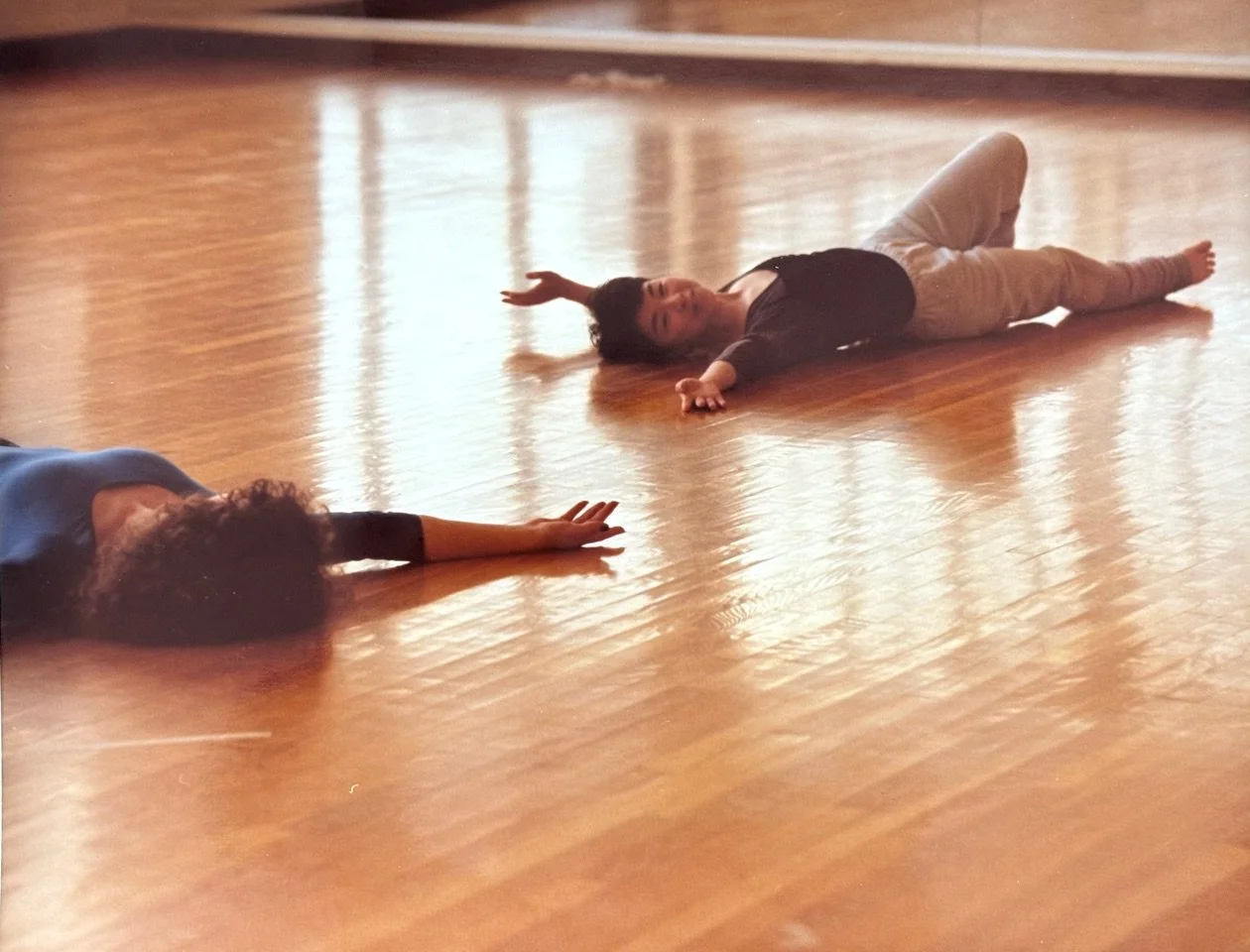
Ting in her San Jose City College dance studio, c. 1983
1983
Leaves the dance company but remains committed to exploring performance based on what Ting described as “movement, ritual, and history.” Takes up painting and printmaking again. Establishes her own art studio by the house in San Jose.
Embraces printmaking, specifically monotypes. The printmaker Joseph Zirker includes Ting’s prints in the exhibition Monotypes A to Z at San Jose City College Gallery, San Jose, CA.
1984
Participates in an evening of performance art that includes the work of Heidi Bekebrede, Lisa Jones, Lisa Venuti, and Anna Koster at 248 Auzerais Avenue, San Jose.
1985
Ting’s father dies, creating a profound emptiness in Ting.
1986
June 20: Shares her thoughts on pastel as a medium in a letter to Martina Norelli, Associate Curator of Graphic Arts at the National Museum of American Art:
“Without sounding too sentimental, I have to say that pastel is a most romantic medium. I love the physical sensation of working with the slightly powdery sticks, pressing them into richly surfaced paper, and smudging or clarifying marks with nothing more than all my finger tips, or at the most, a piece of cloth. It is like gardening, planting seeds in the earth and waiting for the plants to grow.”
1987
April: Attends the St. Francis Retreat in San Juan Bautista, CA.
June 8: Discusses her turn to performance in a letter to Norelli: “There were about ten years (while my children were small) when I found it difficult to work in a studio. In order to spare myself of feeling torn and frustrated and to do justice to the most immediate task at hand, I decided to take a sabbatical from the studio. During that time, I furthered my studies and explorations, and found performance to be the most appropriate. Now my children are teenagers. Four years ago, we built a studio for me to use. Words cannot tell you the dread and excitement I still feel when I enter my studio every morning and realize this time and space is for the sole purpose of my working. Much had to be re-acquainted with, not the least of all, discipline. It has not always been easy, but I must say, I have savored every bit of the journey so far, and I cannot help but look forward to whatever happens in the future with awe and anticipation.”
September: Presents the first public solo exhibition of her monotypes at the Asian Resources Gallery, Oakland, CA.
September 17: Discusses her upcoming exhibitions at San Jose City College, the Triton Museum of Santa Clara, and the Asian Resource Gallery in a letter to Norelli:
“Fall seems to have decided to strike a difference. All not quite of a sudden, I find myself faced with the chance of three exhibitions simultaneously. The first of which you have received the announcement. The second is a faculty exhibition at the San Jose City College where I am teaching, and the third is the inaugural exhibition at the new building of the Triton Museum of Santa Clara titled, Contemporary Vision: An Asian American Aesthetic, a group show in which I will be showing five paintings.
Last week, I went to install my show in Oakland at the Asian Resource Gallery, which is actually located in the lobby of the Asian Resource Center. I had such wonderful feedback and encouragement from the people passing by and who stopped to ask questions or just to talk that I felt reaffirmed in what I sense as my mission as an artist. Sometimes, I work for so long alone that I forget that one vital aspect of art is the sharing with the public. What a responsibility it is to be the only one that can open this particular window (everyone has his or her own to reveal) as no one else can. I feel privileged and humbled.[...]
P. S. I am going to Paris for a week to wander and then to Burgundy to house-sit a studio for another week, Oct. 23–Nov.7.”
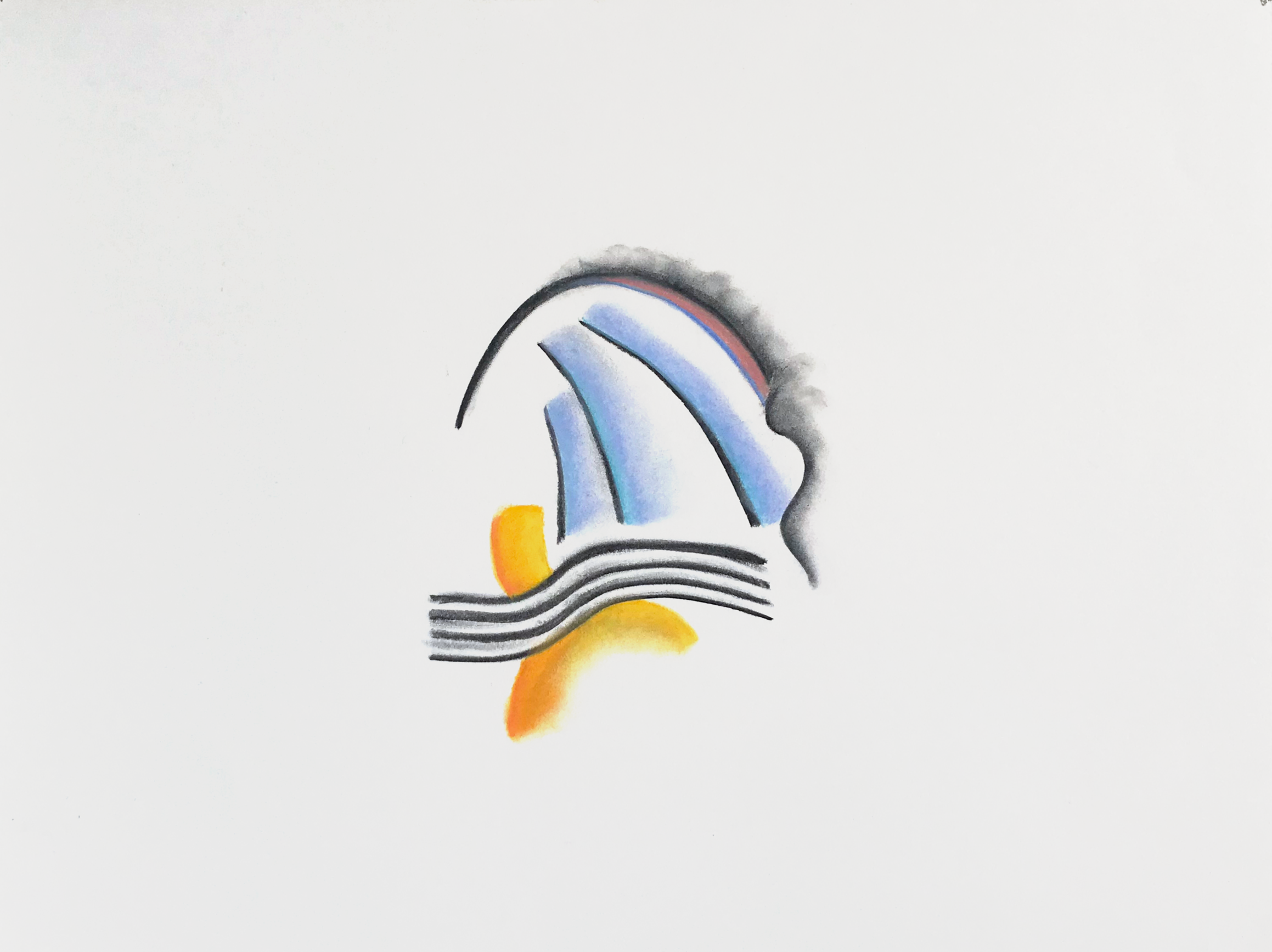
Windows on Taos 1, 1989
1988
Recounts her trip to Paris in a letter to Norelli: “My trip to Paris and Burgundy was beyond words. After I came home, I did everything I possibly could in order to cling to the aura a little longer, including sleeping and waking to French time as long as I could, staying within myself whenever. It had been one of those rare experiences where consciousness was suspended somewhere between the real and imagined. I took many walks in Paris, often tracing the foot-steps of Hemingway, all the time hearing in my head those words he had written so long ago about the people, places, and times, from which he gained insight and expressed the first surge of his creativity.”
Travels to New Mexico with Andrew to lift her spirits after the loss of her father and older brother Percy. Originally intending to attend the Santa Fe Opera, the couple take a detour to Taos. Ting is so taken by Taos that she buys a one-room house, which becomes the site of her second studio.
Participates in a workshop led by the renowned choreographer Anna Halprin at the Mount Madonna Center in California. Sherwood Chen and Hiroko Tamano were the other dance artists with whom Ting had studied.
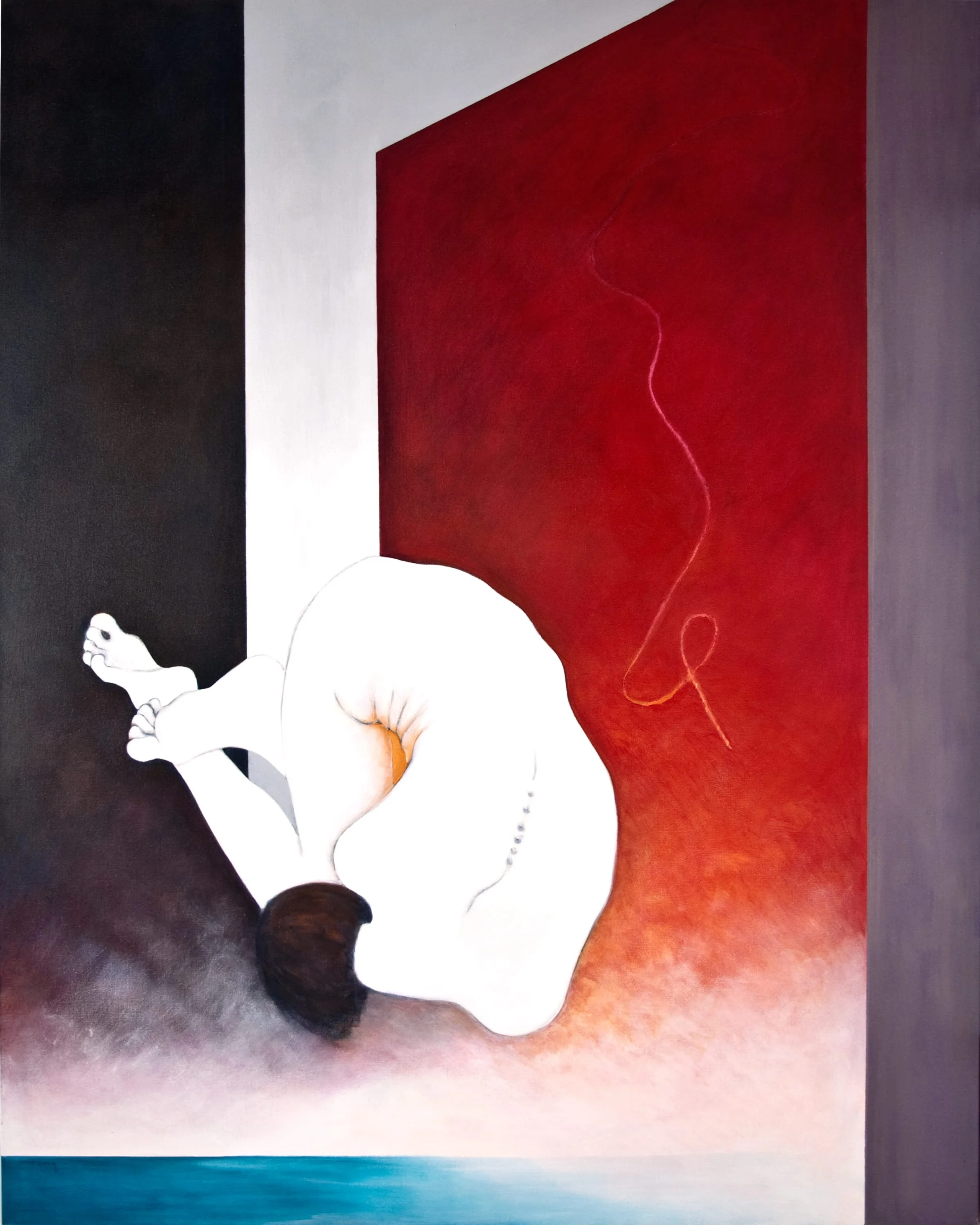
Egress: Beyond the Gate (after Tiananmen), 1990
1991
The magazine Mandarin Oriental publishes a feature article on Ting. Ting reiterates:
“I’m not making ethnic art. I’m dealing with images universal to our humanity.”
1989
Creates a series of pastel drawings titled Windows on Taos. These works combine her affinity for gesture, love of Kandinsky, and the newfound colors of Taos. Stages a performance art piece titled Just Slide By at San Jose City College. Introduces figures performing signature dance gestures by the likes of Merce Cunningham and Martha Graham in her monotypes. States to the San Jose Mercury News: “It’s hurtful because in our expectations of ourselves, we never fit. I don’t make ethnic art, I deal with issues that are universal. I feel lost in the crack somewhere.”
June 3: Heavily armed troops and armored vehicles move into the city center of Beijing to “clear” the pro-democracy demonstrators from Tiananmen Square. Ting paints a work titled Egress: Beyond the Gate (after Tiananmen), 1990.
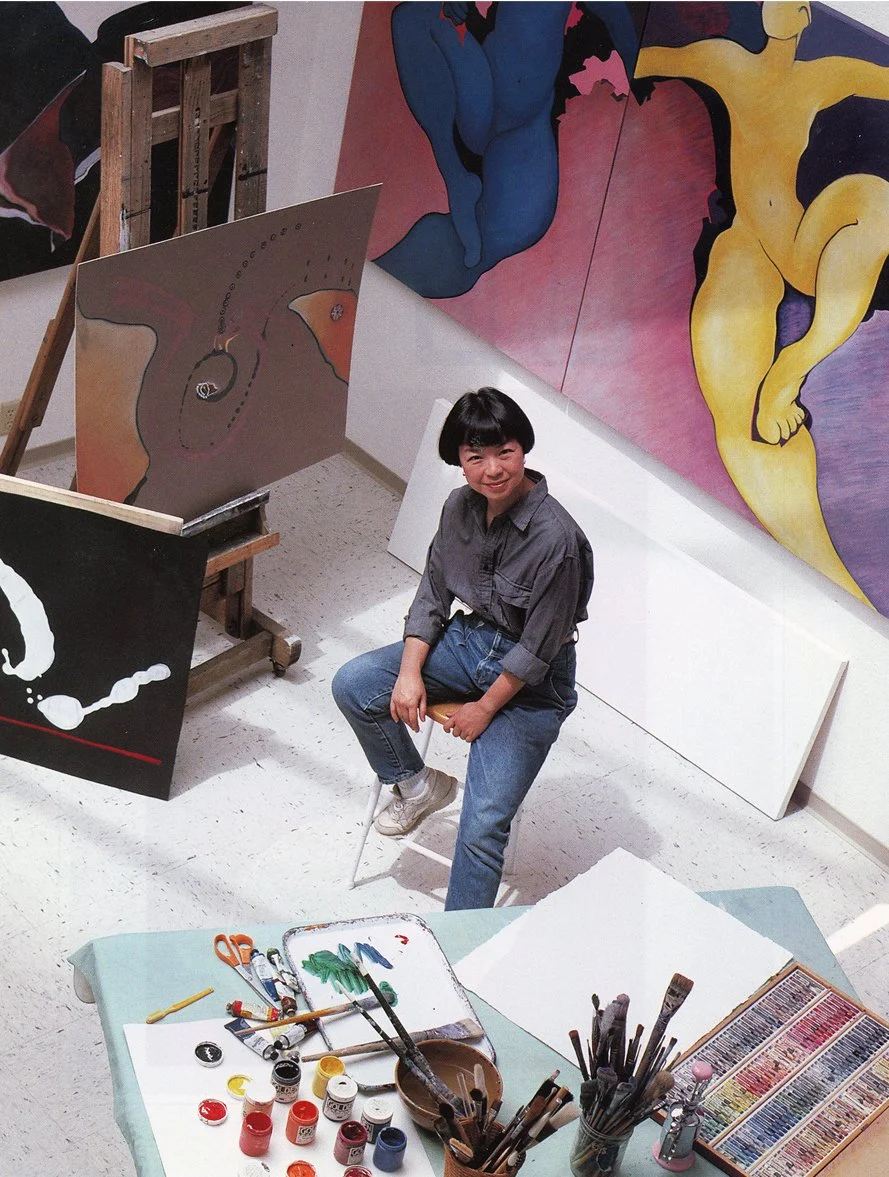
Mimi in her studio in San Jose. Published in Jane Mont, “Explosive Imagery,” Mandarin Oriental 7, no. 1 (1991).
1993
First solo exhibition in Taos opens at the Taos Fine Art Gallery curated by Suzanne Perna. Ting tells The Taos Tempo Magazine:
“I am filled with wonder about nature. Much as a farmer listens to the season, I honor the natural rhythms of life.”
1995
Describes the impact of working in Taos to The Willow Glen Resident: “There’s a certain quality of light, a formal relationship between sky and earth. There’s a tremendous sense of space and reaching.”
2000
Maintains her studio in Taos while visiting family in the Bay Area. Regularly travels to Hong Kong to see her mother.
July 9: Ting’s first grandchild, Maia, is born.
2001
September 4: Ting’s second grandchild, Dylan, is born.
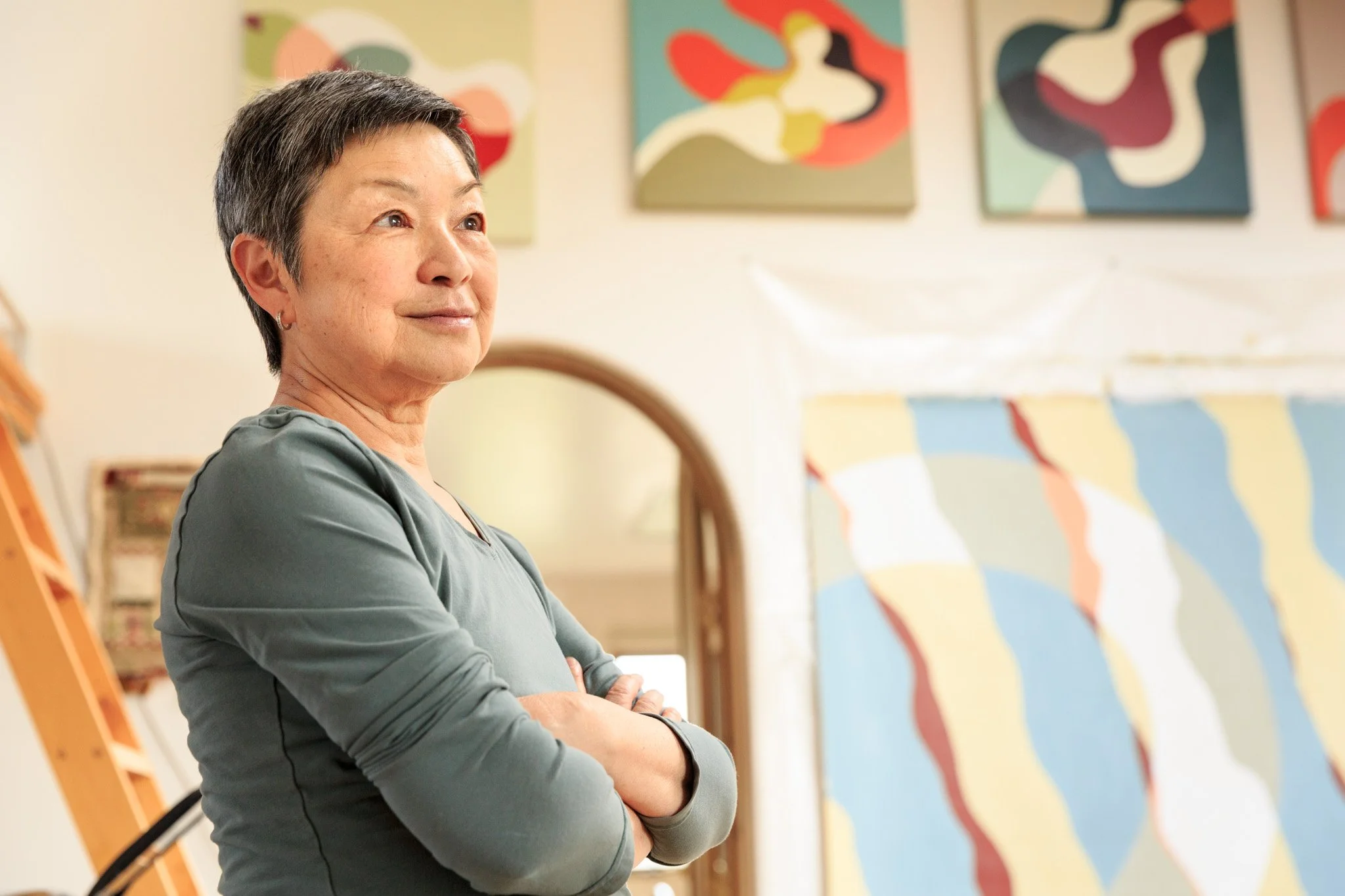
Ting in her studio, 2005
2003
Performs How to Make a Book and Eat It Too at the Millicent Rogers Museum in Taos, a work made possible by a grant from the National Endowment for the Arts. Establishes her Sausalito studio at the Industrial Central Building (ICB). Maintains this studio until her death in 2022.
2005
As part of a celebration of Asian art and culture at the Harwood Museum of Art, Taos, three of Ting’s paintings are selected to be exhibited in the museum: Hanging on this Side of Blue, Blue Danube Waltz, and 2001: Space Odyssey. Ting is invited to perform. She presents Ghosts Revisited, a revisitation of the 1979 performance. Ting introduces the performance explaining, “While scrambling to the top of Mt. Tamalpais before sunrise one spring, I realize that I am about my grandmother’s age when I began to truly know her. She, who would have had to walk five or six steps for every one of mine, gifted me with the endurance of a long-distance runner.”
2006
Begins a major series of nine paintings focused on string and ribbon––its shapes, colors, and movement––which she would title Tangles and Ties.
September: Participates in “Biennial Southwest 06,” juried by Neal Benezra, Director of the San Francisco Museum of Modern Art and curated by Douglas Fairbank at the Albuquerque Museum of Art and History.
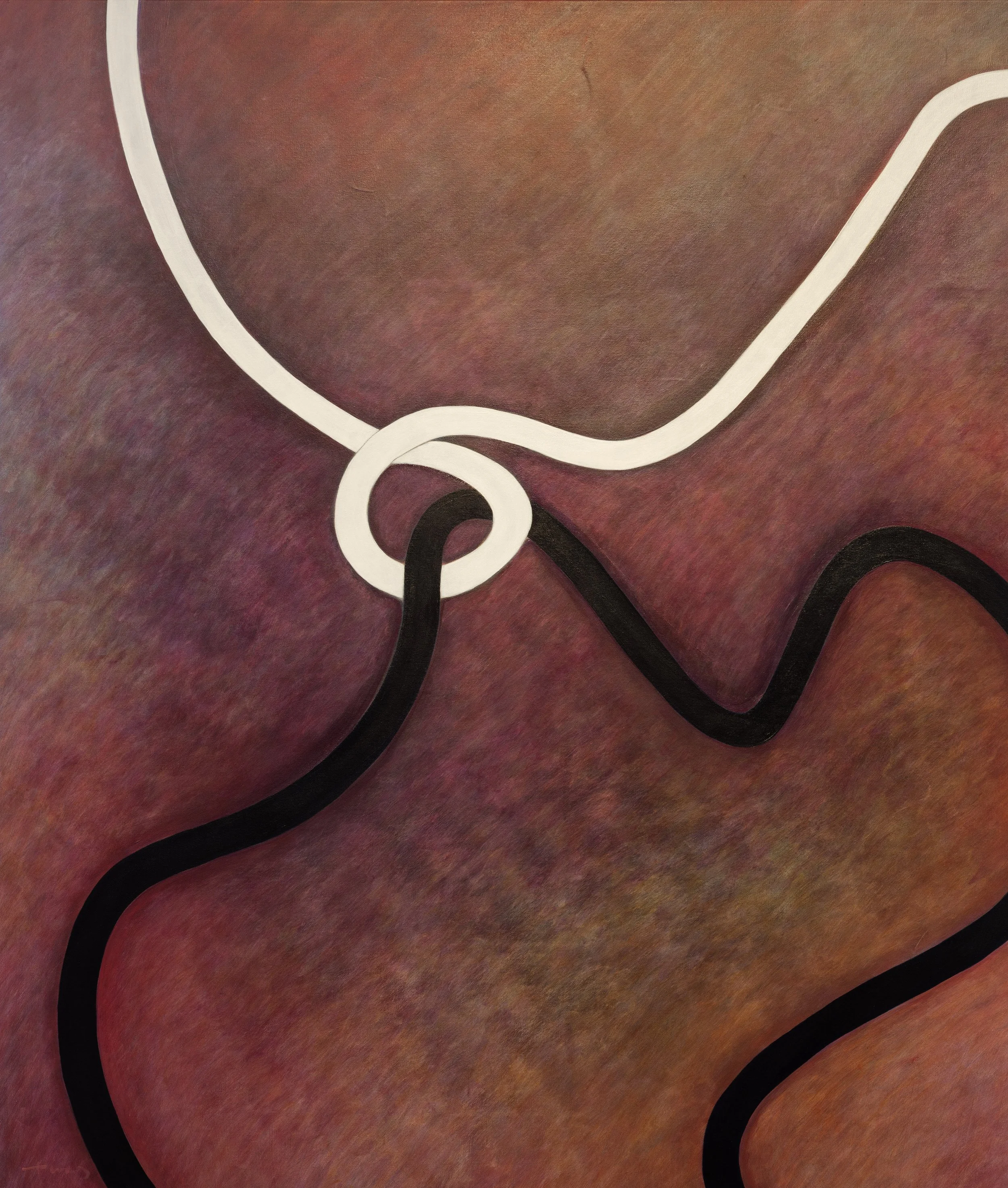
Tangles and Ties IV (detail)
2008
October 5: First solo exhibition in Hong Kong opens at Art Beatus featuring the series Tangles and Ties.
2011
Tells The Taos News Tempo Magazine:
“My path is smoothest when I am willing to fall. I came from a culture that discouraged one from talking too much. I'd be sent to my room for asking too many questions. I finally can ask all the questions I want now, without being sent to my room. I am already in my room.”
2012
July: Awarded the Agnes Martin Award for Abstract Painting and Drawing from Fall Arts, Taos, NM.
Two paintings, Confetto I and Confetto II, enter the permanent collection at the Hayward Museum of Art, Taos, NM.
Ting’s third grandchild, Kaya, is born.
2015
Ting’s fourth grandchild, Mona, is born.
2016
October 7: Ting’s mother dies.
2019
January: Receives a diagnosis of cancer.
October: Spends a final month in her Taos studio and completes the triptych Moon on the Move.
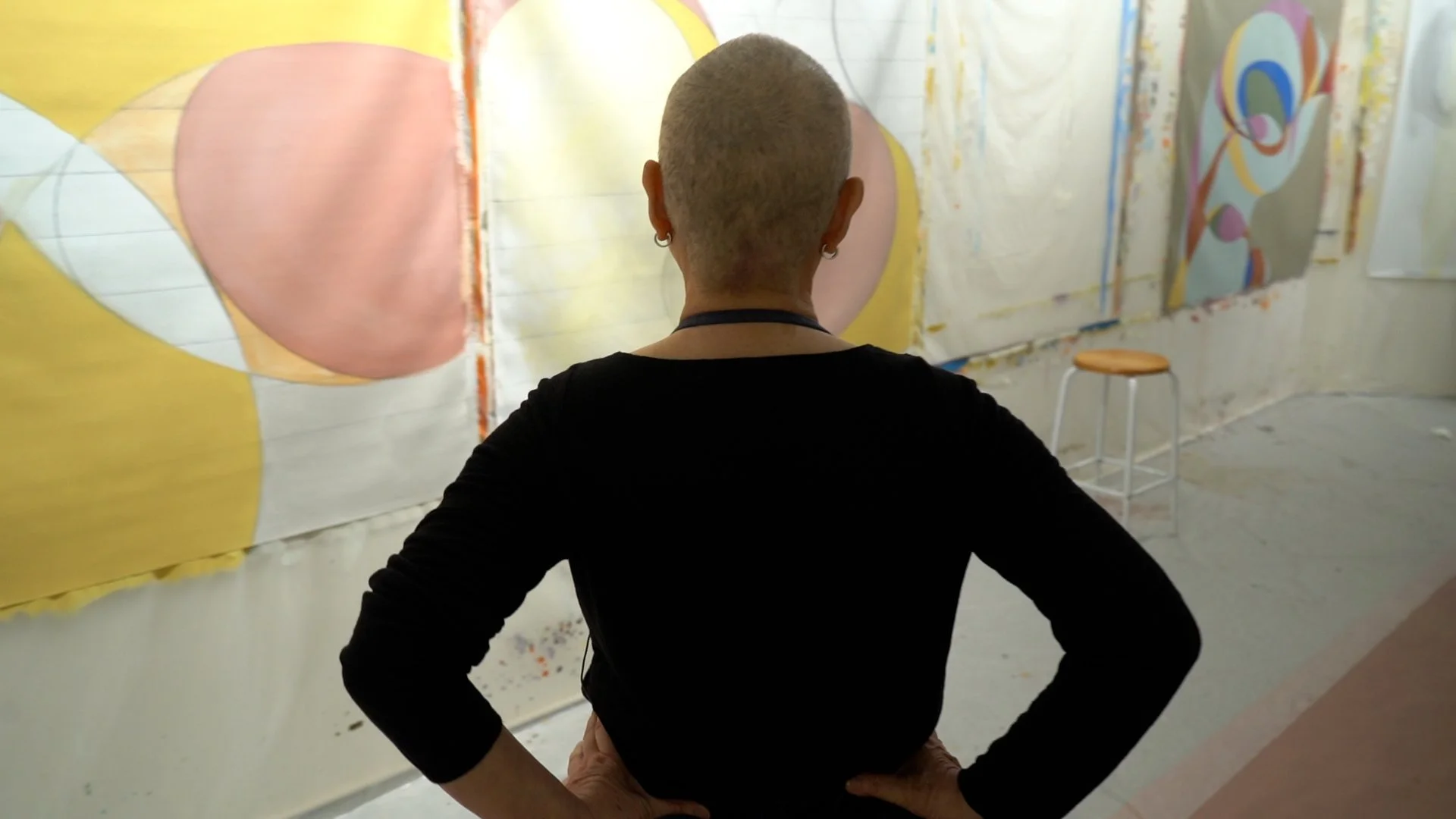
Ting painting in her studio, Sept. 2020
2022
Completes her final painting Last Songs in her Sausalito studio.
March 6: Ting dies at her home in Marin County, CA, surrounded by family.
2023
September: First survey of Ting’s work, curated by Holly Shen, opens at the University Art Gallery at Sonoma State University.